
- Global Market, Gold Market
- Posted on August 22, 2026
Gold’s Wild 2026 Has Left Some Investors Back Where They Started
Gold has experienced one of its most volatile years in recent memory.
It reached a record above $5,400 an ounce in January 2026, fell towards $4,000 by June, and has now climbed back above $4,600.
On Friday, August 21, spot gold surged 2.4% to $4,623.94 an ounce and briefly reached $4,631.99, its highest level in more than three months. That completed a weekly gain of more than 5% and marked gold’s third consecutive week higher.
Those numbers suggest a strong market. But there is another way to look at 2026.
An investor who bought gold close to January’s record is still below the price they paid, despite months of extraordinary events that might ordinarily be expected to support gold.
That raises a more interesting question than whether gold is up or down today: What would it take for gold to make its next decisive move?
—
A year of enormous movement, without a clear destination
The scale of gold’s journey is easy to underestimate.
The World Gold Council’s 2026 mid-year outlook describes one of the most dramatic starts to a year in the modern gold market. Gold crossed $5,500 intraday in January before falling below $4,000 towards the end of June.
The World Gold Council separately records a January high of $5,405 using the LBMA PM benchmark. Different gold benchmarks and intraday prices can produce slightly different highs, which is why comparisons should always use a consistent price series.
The important point is the scale of the move. Gold lost roughly a quarter of its value between its early-year peak and June low before beginning its latest recovery.
It did so while investors were dealing with war involving Iran, disruption to global energy supplies, changing interest-rate expectations, unusually high bond yields, concerns about U.S. government debt, and continued central-bank demand for gold.
For an asset often associated with stability, 2026 has been anything but quiet.
Readers can follow the latest market level on the GoldRates live gold price page.
—
There is no single gold return
This is particularly important when looking at gold from a global perspective.
International gold is usually discussed in U.S. dollars, but most people around the world do not actually buy gold using dollars.
An investor in India sees gold in rupees. Someone in Britain sees it in pounds. Buyers in Europe, Australia, Canada, China and Japan experience gold through their respective currencies.
That means two people who bought gold on exactly the same day can earn different returns.
Exchange rates explain why. Suppose international gold falls 5% in U.S. dollars while a buyer’s domestic currency falls 8% against the dollar. The local gold price may actually rise. The reverse can happen when the local currency strengthens.
This is why claims that gold has produced zero returns over a particular period need context. The result depends on the dates selected, the gold benchmark being used, and the currency in which the return is measured.
The World Gold Council publishes a multi-currency gold returns database.
GoldRates also explains why gold prices differ between countries.
—
So what could finally push gold out of this range?
There is no shortage of potential catalysts.
The World Gold Council’s mid-year outlook suggested that, under a relatively stable global economic environment, gold could remain broadly rangebound. But it also identified several developments capable of producing a breakout. Some of those developments are already beginning to appear.
Interest rates and bond yields
This may be the most important factor in the immediate future.
Gold does not pay interest. When inflation-adjusted bond yields rise, investors can receive increasingly attractive returns from government debt. That raises the opportunity cost of holding gold. The reverse can happen when yields fall.
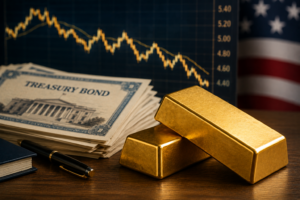
We saw an unusually clear example this week. On August 19, the U.S. Treasury announced an expansion of its long-term bond buyback programme. Global bond yields initially fell, the dollar weakened, and gold jumped more than 4%.
By Friday, gold had broken above its 200-day moving average and reached a three-month high.
The World Gold Council says Western ETF demand may remain particularly sensitive to real yields, monetary-policy expectations and the U.S. dollar during the remainder of 2026.
That makes the direction of interest rates one of the clearest potential triggers for gold’s next major move.
The U.S. dollar could be just as important
Gold and the dollar often pull in opposite directions.
Because international gold is denominated in dollars, a weaker U.S. currency generally makes gold less expensive for buyers using other currencies.
The dollar came under renewed pressure this week. Reuters reported that it fell almost 1% over the week as investors continued to assess U.S. fiscal conditions and the Treasury’s intervention in the bond market. At the same time, gold reached a three-month high.
The relationship is not perfect. There are periods when gold and the dollar rise together. But a sustained weakening of the dollar would remove another obstacle to higher gold prices.
Iran remains an unpredictable factor
The conflict involving Iran has demonstrated why the relationship between war and gold is more complicated than it appears.
Gold initially fell sharply during the conflict. Reuters reported that bullion declined from its January record to below $4,000 in June as investors sought liquidity, energy prices surged, and expectations for interest rates changed. Gold subsequently recovered about 9% during the first part of August as some investors began rebuilding positions.
The conflict remains far from resolved. Brent crude approached $95 a barrel this week as disruption continued around the Strait of Hormuz.
That creates two competing forces for gold. Greater geopolitical uncertainty can increase demand for safe-haven assets. Higher energy prices, however, can increase inflation and keep interest rates elevated.
Iran could therefore become a catalyst for gold in either direction depending on how the conflict affects inflation, currencies and financial markets.
For more context, see GoldRates’ analysis of the relationship between oil and gold prices.
Central banks have not disappeared
One of the strongest arguments supporting gold over the longer term has changed relatively little during the price swings of 2026.
Central banks are still buying.
The World Gold Council recorded 289 tonnes of central-bank purchases during the second quarter of 2026. It expects central banks to remain significant net buyers during the remainder of the year, although total annual purchases may finish below 2025 levels.
In the World Gold Council’s latest reserve-manager survey, 89% of respondents expected global central-bank gold holdings to increase over the following 12 months. A record 45% expected their own institution to increase its gold holdings.
Central banks are not necessarily trying to time the next $100 move in gold. Their decisions are often connected to reserve diversification, inflation protection, and geopolitical risk.
That makes their demand different from short-term speculative buying. It can provide underlying support without preventing substantial corrections along the way.
Investors may ultimately decide the next move
Central banks are only part of the demand picture. Investment demand is increasingly important.
The World Gold Council reported that total gold demand, including over-the-counter activity, reached 2,522 tonnes during the first half of 2026, up 2% from a year earlier. The value of that demand reached a record $380 billion.
But investment demand has not moved in a straight line. Gold ETFs recorded a 45-tonne outflow during the second quarter as weaker gold prices, a stronger dollar and changing inflation and interest-rate expectations affected investor appetite.
The World Gold Council expects investment to be the principal source of demand growth during the remainder of the year, with Asian investment and over-the-counter activity playing increasingly important roles.
A sustained return of institutional money to gold, particularly if accompanied by continued central-bank purchases, would look very different from a short-lived price rally driven primarily by traders.
High prices are also changing the physical gold market
There is another side to $4,000-plus gold. It is expensive.
That is affecting jewellery demand. The World Gold Council expects elevated prices to continue weighing on jewellery volumes during the remainder of 2026. Bar and coin demand is also expected to moderate after a particularly strong start to the year.
Normally, very high commodity prices should encourage additional supply. Gold responds slowly.
Mine production is expected to increase only modestly, while recycling has so far produced a measured response despite historically high prices. That limits how quickly new supply can respond if investment demand accelerates again.
—
What should gold investors watch now?
After the extraordinary swings of the first eight months of 2026, the next major move is unlikely to depend on one headline.
Interest rates matter. So do real bond yields and the U.S. dollar.
The Iran conflict and energy prices remain capable of changing the inflation outlook quickly. Central banks continue to provide structural demand, while institutional and ETF investors could determine how much momentum develops if gold breaks higher.
The World Gold Council’s mid-year assessment was that gold could remain broadly rangebound if the global economic environment remained close to expectations. A worsening economy, renewed geopolitical shock, lower interest-rate expectations or substantial dip buying could change that picture. Resilient growth and rising yields could push in the opposite direction.
Gold ended this week above $4,600, having climbed more than 5% in five days. Yet it remains below the extraordinary levels reached at the beginning of the year.
For someone who bought near January’s peak, 2026 may still feel disappointing. For someone who bought near June’s lows, it looks completely different. And for someone measuring their investment in rupees, euros, pounds, yen or Australian dollars rather than U.S. dollars, the result will be different again.
That may be the most useful lesson from gold’s extraordinary year so far.
There is no single answer to how gold has performed. But after months of violent moves without a decisive new direction, the forces capable of producing the next breakout are becoming increasingly clear.
GoldRates.com provides gold prices, tools, and market information for informational purposes only. Nothing in this article constitutes financial or investment advice.



info@goldrates.com
GoldRates provides current gold prices, market data, historical trends and educational resources to help users understand how the gold market is moving across major global currencies.
© GoldRates, All Rights Reserved.
Disclaimer: GoldRates.com provides information for general purposes only. Prices, market data and news may change without notice. GoldRates does not provide financial or investment advice. Users should conduct their own research before making financial or investment decisions.