- Global Market, Gold Market
- Posted on August 30, 2026
Gold Just Suffered a Sharp Selloff. Why Is Goldman Sachs Still Bullish?
Gold ended the week with a violent reversal after Kevin Warsh’s Jackson Hole speech revived expectations of higher U.S. interest rates. Yet Goldman Sachs still forecasts $4,900 for gold by year-end, arguing that central-bank buying and reserve diversification remain powerful structural forces.
—
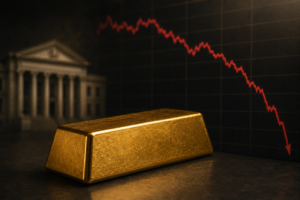
Gold’s latest selloff was difficult to ignore. After climbing to a three-month high earlier in the week, bullion fell almost 3% on Friday as investors rapidly increased their expectations for another U.S. interest-rate increase.
The immediate trigger was Federal Reserve Chair Kevin Warsh’s Jackson Hole speech. As GoldRates reported after the move, Warsh’s insistence that inflation remains too high pushed short-term Treasury yields and the dollar higher, creating a difficult combination for a non-yielding asset such as gold.
Reuters reported that spot gold fell 2.9% to $4,567.23 an ounce on August 28, its lowest level since August 20, after reaching $4,696.18 earlier in the week. The market reaction was accompanied by a sharp repricing of Federal Reserve expectations, with the implied probability of a September rate increase rising to 58% from 36% before Warsh spoke.
Against that backdrop, a bullish gold forecast might appear badly timed. Goldman Sachs Research, however, is sticking with a year-end target of $4,900 an ounce.
—
Goldman’s argument is bigger than the next Fed meeting
In an August 28 research note, Goldman Sachs said it expects gold to reach $4,900 per troy ounce by the end of 2026. The forecast was published as gold was coming off a 15% rebound from its mid-July low to around $4,600 on August 25.
The bank’s central argument is not that gold will be immune to higher interest rates. Friday demonstrated the opposite. Instead, Goldman sees unusually strong central-bank demand as a multi-year force that can continue supporting the market even while monetary policy creates shorter-term volatility.
Goldman estimates that central banks will buy an average of about 50 tonnes of gold per month in 2026. Before 2022, its estimate for the average pace was closer to 17 tonnes per month. The firm’s own measure of official-sector activity accelerated to an annualised three-month pace equivalent to roughly 100 tonnes per month in June, up from 66 tonnes a month earlier.
China was the largest identifiable central-bank buyer in June, according to Goldman. The broader point is that official institutions are purchasing gold at a pace that looks very different from the pre-2022 market.
—
The World Gold Council data support the structural case
Goldman is not alone in identifying central-bank demand as an important change in the gold market. The World Gold Council’s 2026 Central Bank Gold Reserves Survey found that central banks accumulated an average of about 1,000 tonnes of gold annually during the previous four years, roughly double the 500-tonne annual average of the preceding decade.
The survey also suggests that reserve managers do not see that trend ending soon. Of the 76 central banks that responded, 89% expected global central-bank gold reserves to increase over the following 12 months. A record 45% expected their own institution’s gold holdings to rise.
Those intentions matter because central-bank purchases are generally strategic rather than short-term trades. Reserve managers cited crisis performance, diversification, inflation protection and geopolitical risk among the reasons for holding gold.
Actual purchases have also remained substantial. The World Gold Council’s second-quarter Gold Demand Trends data estimated central-bank net demand at 289 tonnes in Q2, five times the revised first-quarter figure and a record for a second quarter. Poland and China remained important buyers, while unreported official-sector purchasing was also elevated.
—
Friday showed why the path can still be violent
None of that makes gold immune to monetary policy. Central-bank demand and Federal Reserve policy operate on different time horizons, and Friday provided a useful demonstration of the difference.
A central bank diversifying reserves may be making a decision intended to last for years. A futures trader responding to a change in U.S. rate expectations may reposition within minutes. Both participants influence the same gold price, but they are responding to very different incentives.
Higher U.S. rates make Treasury securities and cash more attractive relative to gold. They can also support the dollar, making bullion more expensive for buyers using other currencies. When the market suddenly raised the probability of a Fed hike after Warsh spoke, those short-term forces overwhelmed the longer-term demand story.
For readers following the market across currencies, GoldRates live prices provide the current gold price and recent performance in major currencies. Currency movements matter because a large move in dollar gold does not necessarily translate into an identical percentage move for buyers in India, Europe, the United Kingdom, Japan, or Australia.
—
Gold may also be becoming more volatile
There is another part of Goldman’s research that may be especially relevant after Friday’s decline. The bank believes increased use of gold derivatives for portfolio hedging could be amplifying price moves in both directions.
As gold approaches heavily used call-option strike prices, dealers that have sold those options may need to buy gold to hedge their exposure. That buying can reinforce an upward move. The mechanism can work in reverse when prices fall, with dealers reducing hedges and potentially adding to selling pressure.
Goldman therefore describes the outlook as one of greater two-sided volatility. Its $4,900 forecast does not assume an unusually large contribution from derivative hedging, but the growth of those positions could make the journey toward any year-end level much less orderly.
—
The real disagreement is about time
Friday’s selloff and Goldman’s bullish forecast are not necessarily contradictory. The disagreement is largely about the period being measured.
In the short term, gold is confronting a more hawkish Federal Reserve, persistent inflation and a stronger dollar. Those conditions can continue to pressure bullion if markets become increasingly convinced that U.S. rates will rise again.
Over a longer horizon, the structural forces cited by Goldman remain intact for now. Central banks continue to diversify reserves, geopolitical risks remain elevated, and gold occupies a larger role in official reserve strategy than it did before 2022.
Goldman also expects the Fed-related headwind eventually to ease, arguing that inflation should moderate sufficiently for policymakers to remain on hold rather than deliver the degree of tightening markets priced after Jackson Hole. That is a forecast, not a certainty, and Friday’s reaction shows how sensitive gold remains to evidence that challenges it.
—
What would change the picture?
The next phase of the gold market will help determine which force is stronger. If inflation remains stubborn and the Fed follows through with additional rate increases, gold may have to absorb a longer period of restrictive monetary policy. If rate expectations retreat while central-bank accumulation continues, the structural demand argument would regain importance.
Central-bank data will therefore be worth watching alongside inflation releases and Fed communication. A sustained slowdown in official purchases would weaken one of the central pillars of Goldman’s forecast. Continued buying at historically elevated levels would suggest that Friday’s selloff changed the short-term price without necessarily changing the longer-term reserve-diversification story.
For now, the most useful conclusion is not that Goldman Sachs is necessarily right or wrong about $4,900. It is that the gold market is being pulled by two powerful forces at once. Monetary policy can move the price violently from one day to the next, while central-bank demand is reshaping the market over a much longer period.
—
GoldRates provides market information and educational content for general informational purposes. Readers should not treat this article as financial or investment advice.



info@goldrates.com
GoldRates provides current gold prices, market data, historical trends and educational resources to help users understand how the gold market is moving across major global currencies.
© GoldRates, All Rights Reserved.
Disclaimer: GoldRates.com provides information for general purposes only. Prices, market data and news may change without notice. GoldRates does not provide financial or investment advice. Users should conduct their own research before making financial or investment decisions.